

Work Like a Monk
Wisdom from Shoukei Matsumoto

Wabi Sabi Life brings you creative explorations of the imperfect and unconventional from a Buddhist with a love of Japanese culture.
Way back in 2022 I talked about Shoukei Matsumoto’s book ‘A Monk’s Guide to a Clean House and Mind’ . I love that little book. It really helped me find the joy of cleaning.
Matsumoto’s latest book is another serving of Buddhist wisdom in the shape of a conversation between a businessman and monk. But actually this description is a little misleading. In fact the whole premise of the book is misleading. This book is not really about working and business at all. That’s just the edifice.
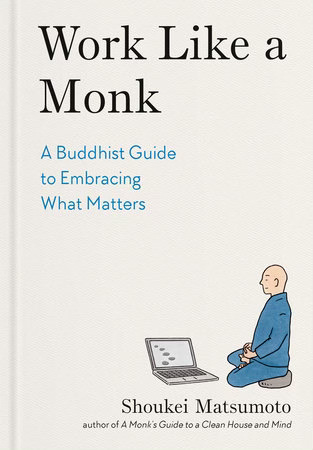
The edition I have has the subtitle ‘How to connect, lead and grow in a noisy world’ and is probably found in the self help or business sections of the bookshop no doubt. But the version in the image above suggests a clearer picture: this is a book about understanding and embracing what matters and is written in Matsumoto’s simple and engaging style.
Monk as Translator
Matsumoto is a Buddhist monk based in Kyoto. He is also a World Economic Forum Young Global Leader, a visiting professor, and a speaker who addresses boardrooms across the world. This is his connection with the bussiness world.
On paper, this combination of identities might seem like a contradiction: the monastery and the management consultancy are not obvious neighbours. But Matsumoto sees no contradiction at all.
“I believe a monk’s role is like that of a translator — not just translating between languages such as Japanese and English, but also interpreting the Buddha’s words for modern times, bridging the gap between Buddhist teaching and the language of business.”
But, this is not a productivity book. It’s not even a book about business or the world of work at all really. I think that’s a little rouse to get a specific audience.
An age of noise
We are living through what Matsumoto calls an age of “noise”. Noise is not simply volume, it is the proliferation of signals that carry no meaning, the acceleration of attention that prevents reflection, the constant availability that dissolves the boundary between thought and response. You know noise, like visual clutter. In this book Matsumoto simply and gently wants to cut through that noise. It might be pitched at the working world but its message is more universal.
Buddhism for a modern world
Despite its simplicity, it brings both the rigour of someone trained in philosophy at the University of Tokyo and the patience of someone who has sat in silence long enough to know what silence actually contains. His book is, among other things, is an argument that the contemplative traditions of Buddhism are not relics of a pre-technological world. They are, in fact, precisely what our wired, fraught and noisy world needs most.
Embracing a more wabi sabi life
Those of us who are drawn to Japanese aesthetics will find much here that feels familiar here. Matsumoto moves through the same territories that draw me to write this Substack column: the understanding that slowness is not laziness, that emptiness is not absence, that beauty and function are not opposites. The monasteries of Kyoto have long known things about attention and the rhythms of a human life that the modern workplace is only now beginning learn.
But this book asks something poignant: whether we have genuinely interrogated the stories we tell ourselves about productivity and purpose, or whether we have simply dressed our existing habits in more aesthetically pleasing language.
How are we shaping our world?
Matsumoto holds an MBA alongside his years of monastic practice. This combination is, I think, more than a biographical curiosity. It means he understands the world of business from the inside, the particular hungers and pressures of the professional world . He is not naive about commerce, nor dismissive of ambition.
He is asking, with great seriousness, whether the way we have organised our working lives is actually producing the things we say we want: meaning, connection, contribution, aliveness.The answer, he suggests, is mostly no.
In the years I have spent thinking and writing about Japanese aesthetics and Buddhism, I have circled the same territory from different angles. What does it mean to be present? What is the relationship between stillness and creativity? How do we work in a way that does not deplete us?
This is our Wabi Sabi Bookgroup read for this month and you can buy it with a 20% discount from the Honnomushi Cat Bookshop (code below) if you are a paid subscriber to Wabi Sabi Life and join the Fable book club space.
This little income is important to me as a part time worker and carer and I appreciate each and every paid subscription. 🌸
I partner with online bookshop Honnomushi Cat Bookshop and Buddhist publisher Windhorse Publications to bring you these book reviews.
🌸 For 20% this book please quote WABISABI20 🌸
Share your thoughts with me and others on Fable.

This is just wonderful and thank you
It is mesmerising and heart warming to read your essays and pieces and this one in particular touched my heart. Lately I lost the Zen after years of practice, solitude and mediation, this essay allowed me to find my Center by working on cutting the noise, which I know something soothes my soul. I am non-Japanese, and lives in Helsinki but to me, whenever I visit Japan, it brings joy in my heart, like Pico Iyer. Here is a gift of what I wrote - https://impactdesignexperiences.substack.com/p/the-sacred-art-of-silence